

We are pleased to share a new HEART-SAFE case report describing, to our knowledge, the first detailed automated detection of a true cardiac arrest using sensor data from a commercially available smartwatch.

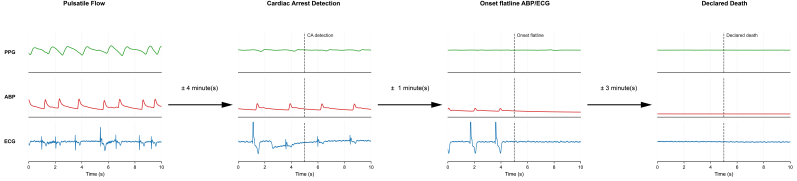
Most automated cardiac arrest detection algorithms have so far been developed and tested using simulated or artificially induced cardiac arrest data. In this case report, smartwatch photoplethysmography (PPG) data were collected from an 82-year-old patient admitted to the intensive care unit with a severe intracerebral hemorrhage and a poor prognosis.
Following shared decision-making with the family, palliative management was initiated. During the end-of-life phase, the patient was continuously monitored using clinical reference measurements, including electrocardiography, invasive arterial blood pressure, and clinical PPG. A commercially available smartwatch was additionally used to collect sensor data before, during, and after cardiac arrest.
When the smartwatch PPG data were retrospectively analyzed using our previously developed cardiac arrest detection algorithm, the algorithm accurately identified the moment of circulatory arrest in agreement with the clinical reference signals.
Although this controlled end-of-life setting differs substantially from an out-of-hospital cardiac arrest, the case provides an important first demonstration that a true, spontaneous cardiac arrest can be identified using consumer-grade smartwatch sensor data.
This finding represents another step toward the development of reliable automated cardiac arrest detection using wearable technology. Prospective studies in real-world out-of-hospital cardiac arrest populations are now needed to determine clinical performance and practical applicability.
The full case report, published in Resuscitation Plus, can be read here.
Add comment
Comments